At the start of the new millennium, the world of ophthalmology hailed a celebration of its own: the 50th anniversary of Sir Harold Ridley's original IOL implant. More recently, a lesser but significant revolution has taken place in the United States: the eclipsing of rigid IOL use by that of foldable lenses. Along with improvements in soft biomaterials and lens designs, there have also been marked advances in foldable IOL delivery systems.
Historically, pioneers in the field of foldable implants, such as Epstein and Mazzocco, Levy, Faulkner and others, worked with unwieldy folding and inserting instruments or rudimentary injectors. Insertion of foldable lenses was disparagingly inconsistent and at times traumatic. The following discussion will review the latest refinements in IOL delivery devices.
Silicone IOLs
Until recently, silicone was considered the mainstay biomaterial used in foldable implants and continues to be widely used today. The choice of an optimal delivery system depends upon the particular elastomer employed, the material's refractive index (and hence its thickness), and perhaps most importantly, lens design.
Three-Piece Designs
Early silicone implants were comprised of low index of refraction elastomers and their central optic
thickness was greater than that of more recent IOLs. Central optic thickness varies depending upon dioptric
power, and can be quite thick for high power IOLs, making handling a challenging task. For this reason,
manual inserting instrumentation had to be robust in design, and great care had to be directed toward
proper loading and inserting.
Newer elastomers boast higher refractive indices and, therefore, maintain thinner profiles. The effective optical zones vary slightly based upon lens power; smaller zones are utilized for higher powers. These thinner lenses can be securely grasped and inserted with slimmer instruments, permitting placement through smaller incisions.
There are three basic orientations by which a three-piece IOL may be folded: 6 o'clock to 12 o'clock, 3 o'clock to 9 o'clock, or 4 o'clock to 10 o'clock (Slide 1A, Slide 1B, and Slide 1C). Certain implant designs (particularly haptic shape and its staking to the lens optic) favor one approach over another. Some surgeons prefer a 3 o'clock to 9 o'clock or 4 o'clock to 10 o'clock fold since both haptics will release simultaneously into the capsular bag. This technique is, however, potentially more traumatic as haptic sweep could injure the posterior capsule. A 6 o'clock to 12 o'clock fold, with manual placement of the trailing haptic, may be preferred in the setting of a compromised capsule. Paradoxically, the so-called "mustache" fold from 3 o'clock to 9 o'clock or 4 o'clock to 10 o'clock avoids rotational movement and may be preferable when faced with weakened zonules.
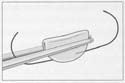
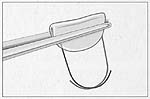
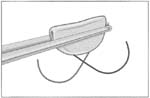
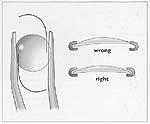
When manually folding a silicone implant, care must be taken to keep both the implant and instrumentation dry because silicone's surface can be slippery. As with all implants, the optic should be placed flat on the loading platform, not tilted nor teetering, and well centered within the loading device (Slide 2). If an uneven fold occurs, the loading should be repeated.
Historically, injector delivery systems for three-piece IOLs were fraught with problems, often leading to unpredictable if not traumatic delivery of implants. Recently, however, a new generation of delivery devices has emerged. These devices have been engineered to allow for remarkably safe, facile, and reproducible placement of IOLs. The first of these devices to reach the marketplace was the Unfolder Sapphire Implantation System (Allergan Surgical, Irvine, Calif.). The Silver Series is used to deliver Allergan's SI30, SI 40 and SA40N Array multifocal implants through potentially unenlarged phaco incisions (Slide 3A). The Gold Series handpiece and cartridge are similar and used for the SI55 IOL (Slide 3B). These metal-threaded injectors incorporate a soft, silicone-tipped plunger, which advances the optic and allows for placement of the trailing haptic (Slide 3C). The metal threads have recently been enlarged, increasing the speed of delivery of the IOL. These injectors require partial rotation along their long axes during delivery for consistent and properly oriented implant placement.
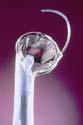
The M-port, produced by Bausch and Lomb Surgical (Claremont, Calif.) is used to deliver their model LI61U three-piece silicone implant. The M-port is a plastic syringe-style device that allows for one-handed delivery without rotation of the device. It has the unique quality of compressing the lens optic into an "M" configuration (Slide 4A, Slide 4B, and Slide 4C). Following placement of the lens optic, the M-port plunger may be retracted and used to insert the trailing haptic. It is currently being downsized to allow for lens placement through incision sizes of 3.0 mm or less.
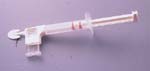

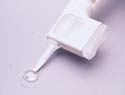
Plate-haptic Designs
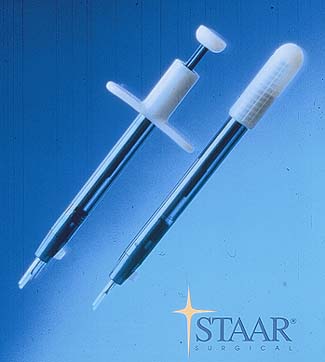
Single-piece plate-haptic silicone implants have lost some of their popularity recently due to improvements in
three-piece designs and newer biomaterials. However, they have been successful over the years in large part due
to their ease of insertion and small associated incision sizes. The only approved toric IOL in the United
States is the Staar Surgical silicone plate design, and therefore this general lens design continues to
occupy an important position among our current armamentarium. Both threaded- and syringe-style injectors
exist for this lens style and allow for placement through incision sizes of 2.8 mm or less (Slide 5).
Acrylic IOLs
Soft acrylic has become a popular biomaterial and is used in the AcrySof (Alcon Laboratories, Fort Worth, Texas) and Sensar OptiEdge (Allergan Surgical, Irvine, Calif.) IOLs. Because of the AcrySof's thermo-elastic properties, mild warming of the lens is commonly employed to soften the implant and facilitate folding and release. This material, unlike silicone, may be wetted with balanced salt solution or viscoelastic and will aid in handling, since the surface of this implant is tacky and prone to surface marring. Inserting instrumentation should be smooth and free of burrs or scratches. The implant may be folded by using the disposable AcryPak produced by Alcon (Slide 6A and Slide 6B), or by conventional instrumentation. By pressing centrally on the undersurface of the optic as the fold is initiated, a proper inverted "U" configuration is achieved. Inserting forceps designed by Buratto or Lehner are popular since they minimize contact with the delicate central optic surface. As compared to a folded silicone lens, the acrylic optic should be grasped lower, toward the open aspect of the fold, to avoid "fish-mouthing" of the optic edges. The 5.5-mm AcrySof optic generally requires a 3.2-mm incision, and the 6.0-mm optic will pass through a 3.8-mm incision. Recently, Alcon has released a one-piece, all acrylic implant, the SA30. This design is particularly well suited for an injector delivery system as described below.
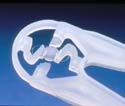

Alcon has further revised their Monarch injector delivery system for both their three-piece and one-piece acrylic implants. This system permits excellent visualization of the folding process and implant delivery. It is a metal-threaded device and requires a 3.0- to 3.2-mm incision (Slide 7). The three-piece Sensar acrylic IOL may be delivered through the Sapphire injector, specifically designed for this implant (Slide 8A and Slide 8B). It requires a 3.2-mm incision.

Hydrogel IOLs
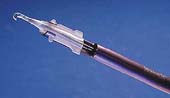
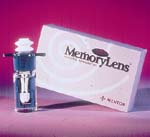
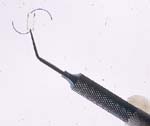
Currently, there are two hydrogel acrylic implants approved by the U.S. Food and Drug Administration. The Mentor MemoryLens (CIBA Vision, Atlanta, Ga.) is the only IOL that is available pre-rolled from the manufacturer, obviating the need to fold the implant (Slide 9A, Slide 9B and Slide 9C). It is simply removed from its package and inserted directly into the incision. Round-bodied forceps are the most appropriate tools for insertion. Specifically designed instruments may be used to help minimize incision size and improve holding power upon the grasped optic. Typical incision size ranges from 3.5 mm to 3.8 mm. As the leading haptic is being placed, care must be taken to angle in a clockwise direction so that the broad C-shaped haptics are properly positioned under the anterior capsular leaflet. The trailing haptic is placed in a conventional manner. Unfolding of the optic then takes place over several minutes. It is not necessary to visualize the lens' final position.

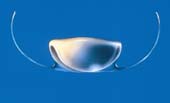
The other recently approved hydrogel implant is the Hydroview (Bausch and Lomb Surgical, Claremont, Calif.). This IOL, by virtue of its bonded haptics, is said to behave more as a one-piece design. It is currently being marketed internationally in conjunction with the Surefold delivery system (Slide 10A and Slide 10B). After squeezing the disposable Surefold, the lens is folded along its 6 o'clock to 12 o'clock axis. The lens is then grasped and inserted with simple forceps. Folding in any other orientation risks damage to the bonded haptics. Incision size will range from 3.5 mm to 3.8 mm, depending upon IOL power.
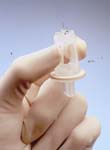
Avoiding Trouble
Most complications that occur when inserting a foldable implant are related to one of two problems: either the implant was not loaded properly into the folding/loading device, or the surgeon attempted to force the IOL through an incision that is too small.
Improper loading of the implant can be avoided by devoting the necessary attention to the details of the loading process. As previously mentioned, when manually folding and loading a three-piece implant, care must be taken to ensure that the lens is flat on the loading surface. An uneven fold will probably result if the lens is tilted. This may lead to premature release from the inserting forceps. Most loading devices have demarcations or "hash marks" to help align the center of the lens optic with the center of the loading device. Similar care must be given to the centering and positioning of an implant when using an injector delivery device.
When it comes to incision size, most surgeons would agree that smaller is better. Unfortunately, forcing an implant through an inadequately enlarged incision has been shown to traumatize the wound and potentially compromise its ability to self-seal. In addition, there is a risk of premature release of the implant with subsequent ocular injury and/or damage to the implant.
Conclusion
Refractive surgeons have a number of choices to consider with regard to foldable IOLs. The ultimate decision will depend upon the optical performance of the lens, its biocompatibility, its associated incision size, and finally, its ease of insertion. Fortunately, the latest generation of delivery devices has greatly improved the facility and reproducibility of inserting contemporary small incision implants.