The wide use of lasers in ophthalmology has not escaped the field of cataract surgery. Now, surgeons can offer their patients cataract laser surgery. In June 2000, the U.S. Food and Drug Administration (FDA) approved the first laser device for clinical use in the United States, and additional devices are likely to enter the market in the near future.
Surgeons may be wondering why laser technology should be used when phacoemulsification offers a relatively safe procedure with few complications. But, in past years, a variation of that same question may have been asked: Why should phacoemulsification be used when extracapsular cataract extraction offers a relatively safe procedure with few complications? The availability of the laser in cataract surgery allows safe surgery through a smaller incision, and, therefore, it is worthy of attention.
Laser versus Phacoemulsification
Phacoemulsification generates heat by transforming electrical energy to mechanical energy with the subsequent generation of emulsifying shock waves.1 Conversely, the laser probe produces no significant heat2 and, therefore, requires no surrounding cooling irrigation bath. This lack of heat production provides two clear advantages. First, it eliminates the risk of a rare, but dreaded, complication of phacoemulsification, a corneal burn, which may induce significant astigmatism and corneal endothelial cell compromise. In severe cases, a corneal burn may require a penetrating keratoplasty. Second, it allows for the separation of the irrigation port from the emulsifying needle. This latter development allows the use of a handpiece of reduced diameter and demonstrates that laser technologies are able to use smaller wound sizes than are possible with current phacoemulsification devices.
Dodick Photolysis
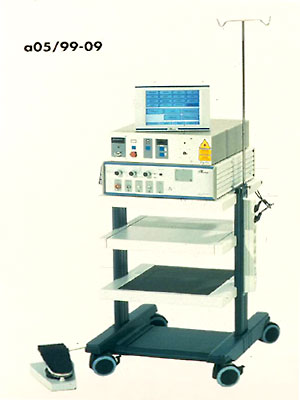
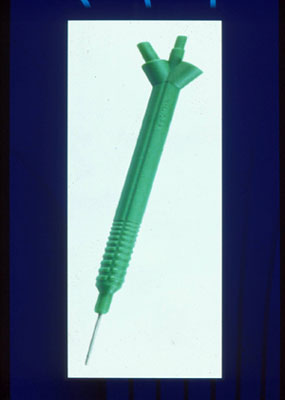
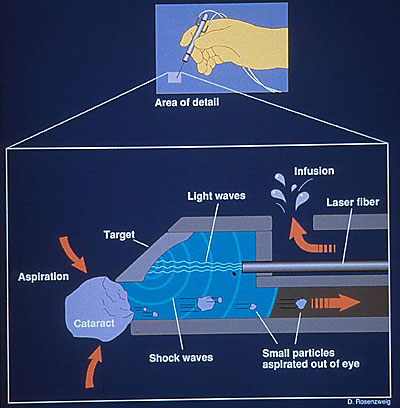
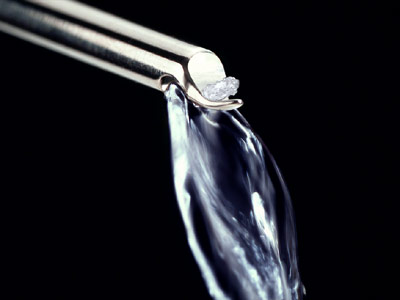
The only laser unit currently approved by the FDA for cataract removal is the Dodick PhotoLysis System (Laser Corp, Salt Lake City, Utah) (Slide 1), a Q-switched neodymium:yttrium-aluminum-garnet laser (Nd:YAG, 1064 nm). This device transfers laser energy in a Q-switched (pulsed) mode from a laser source, via a quartz-clad fiber optic, to a laser probe (Slide 2). At the distal end of the probe, the laser beam is directed onto a titanium plate that resides just within the tip of the probe. This titanium target allows for optical breakdown of the laser energy at a greatly reduced threshold than would otherwise be required without such a target. Therefore, plasma formation occurs at a much lower energy level and results in emanating of shock waves from the tip of the laser probe. These shock waves then emulsify the cataract material, which is subsequently aspirated through the same probe (Slide 3).
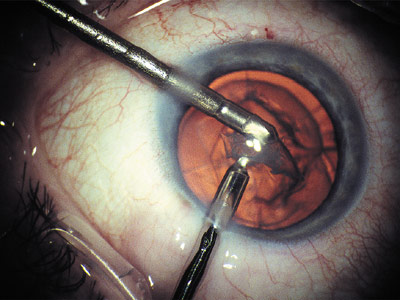
The Dodick PhotoLysis System currently requires two 1.4-mm paracentesis ports, one for the laser/aspiration probe and the other for irrigation (Slide 4). Several irrigation tips are available. One version is a rounded irrigation tip that directs irrigation laterally, similar to the phaco tip. Another version is the Wehnerspoon irrigation tip, which is constructed with an irrigation port on its posterior surface to direct the fluid toward the posterior capsule and a spoon on its anterior surface to support lens nuclear material for the laser to disrupt (Slide 5). After disruption and removal of the lens nucleus, bimanual irrigation and aspiration probes are used to remove the remaining cortical material.
Decreased Energy
The Dodick PhotoLysis System delivers a maximum energy of 10 mJ per pulse, with a pulse duration of 10 nanoseconds, in a frequency of 1 Hz to 20 Hz. Huetz and Eckhardt studied a series of 100 eyes undergoing photolysis using the Dodick PhotoLysis System. The investigators found that the amount of energy required for removal of cataracts with minimal to maximal nuclear opacity ranges from 1.97 J to 7.7 J.3 Kanellopoulos and colleagues reported a mean intraocular energy of 6.7 J in their series of the first 100 cases performed using the Dodick PhotoLysis System.4 The mean intraocular energy was reduced to 5.65 J in the follow-up study of the first 1000 cases.5
There is a significant difference between the energy delivered by phacoemulsification and the Dodick PhotoLysis System. In a study comparing the phaco-chop technique with the divide and conquer technique, DeBry and colleagues reported that the phaco-chop technique reduced the energy delivered by phacoemulsification from a mean of 3264 ± 1218 J to 782 ± 446 J, which reflects a significant reduction.6 Recently, Fine and colleagues reported using power modulations and altered phacoemulsification techniques to deliver lower ultrasound energy, which they estimate to be as low as in the single digits.7 The latter numbers, albeit estimated, certainly rival the statistics of photolysis. However, it must be remembered that the photolysis studies reflect the early cases and the inherent learning curve. A further reduction in the amount of intraocular energy used can be expected as laser techniques are further refined.
Safety
Endothelial cell function is a postoperative concern for cataract surgeons; damage to the endothelial cells can impair corneal recovery and significantly impact postoperative results. Kanellopoulos and colleagues showed an endothelial cell loss of 7.55% with the Dodick PhotoLysis System. This value is comparable to current phacoemulsification results.4
Corneal pachymetry is a useful measurement to evaluate postoperative recovery. Studies show that at 6 months postoperatively, there is no significant difference between preoperative and postoperative corneal pachymetry3 using laser photolysis for cataract surgery. Huetz and Eckhardt demonstrated that in mild to moderately dense cataracts, there was no difference in preoperative and postoperative pachymetry values on postoperative day 2. In patients with severely dense cataractous lenses, there was an increase of 1.9% in postoperative pachymetry on day 2, but at 6 months postoperatively, there was no significant change when compared with the preoperative values.3
Because laser energy generates no significant heat, the surgeon can disregard any concern for a corneal burn and is able to operate through a much smaller wound. In contrast to phacoemulsification, a tighter wound is preferable because it permits the fluid and the nuclear lens material to leave the eye by only one pathway, the aspiration port. A leaky wound will depressurize the eye and, therefore, may decrease the efficiency of lens material aspiration. Surprisingly, then, a smaller, tighter wound is preferable in photolysis.
Intraocular Lenses
Currently, there is no intraocular lens (IOL) available that can be inserted through a 1.4-mm incision; lenses are under investigation and are being combined with laser photolysis to minimize wound enlargement to under 2 mm.5 However, due to the ever-shrinking size of emulsification and irrigation probes, it will be incumbent upon manufacturers to develop IOL technology to match or surpass these small wounds.
Future Developments
What does the future hold — possible endocapsular cataract surgery? Perhaps, the capsulorrhexis will eventually go the way of zonulysis, and the ophthalmic surgeon will be able to aspirate the cataract through anterior capsule puncture wounds. Upon completion of nuclear and cortical removal, instead of reinflating the capsular bag with viscoelastic, perhaps the surgeon of the future can reinflate it with an injectable lens material. The patient of the future may no longer be required to choose between best-corrected distance and near vision, but, rather, the accommodation will be preserved. One can only speculate about the possible technological developments. But with the introduction of lasers to the armamentarium of cataract techniques, it is certain that doors are being opened to the future.
References
- Kelman CD. Phaco-emulsification and aspiration. A new technique for cataract removal. A preliminary report. Am J Ophthalmol. 1967;64:23-25.
- Alzner E, Grabner G. Dodick laser phacolysis: Thermal effects. J Cataract Refract Surg. 1999;25:800-803.
- Huetz WW, Eckhardt HB. Photolysis using the Dodick-ARC laser system for cataract surgery. J Cataract Refract Surg. 2001;27:208-212.
- Kanellopoulos AJ, Dodick JM, Brauweiler P, Alzner E. Dodick Photolysis for cataract surgery: Early experience with the Q-switched neodymium:YAG laser in 100 consecutive patients. Ophthalmology. 1999;106:2197-2202.
- Kanellopoulos AJ, et al. A prospective clinical evaluation of 1000 consecutive laser cataract procedures using the Dodick Photolysis neodymium:yttrium-aluminum-garnet system. Ophthalmology. 2001;108:1-6.
- DeBry P, Olson RJ, Crandall AS. Comparison of energy required for phaco-chop and divide and conquer phacoemulsification. J Cataract Refract Surg. 1998;24:689-692.
- Fine IH, Packer M, Hoffman RS. Use of power modulations in phacoemulsification: Choo-choo chop and flip phacoemulsification. J Cataract Refract Surg. 2001;27:188-197.