Andrew G. Lee, MD
Clinical Evaluation
The upper eyelid typically covers the superior cornea by 1 mm to 2 mm. Likewise, although there is individual variation, the lower eyelid typically sits just below the inferior corneal margin. The levator palpebrae superioris muscle is innervated by the third cranial nerve and Müller's muscle is innervated by the oculosympathetic system. A muscle equivalent to the superior Müller's muscle is found in the lower lid.
Upper lid retraction describes an abnormally high lid position in primary position that exposes the superior sclera between the eyelid margin and the superior limbus. Lid retraction may be transient or constant. The lid retraction may be related to overactivity or contracture of the levator muscle, aberrant or increased innervation to the levator, decreased inhibition to the levator muscle, or sympathetic hyperactivity of the Müller's muscle.
Apparent lid retraction of the lid may occur in myasthenia gravis, after an orbital floor "blowout" fracture with globe hypotropia, after facial nerve palsy, or due to ptosis of the opposite eyelid (pseudoretraction). Occlusion of the eye on the side of the ptosis resolves the retraction in neurogenic pseudoretraction (Hering's law of equal innervation).
Transient Lid Retraction
Transient lid retraction may be seen in up to 80% of normal infants aged 14 to 18 weeks (eye popping reflex). This finding is benign and typically resolves spontaneously. Transient congenital lid retraction may also occur due to maternal hyperthyroidism. Neurogenic lid retraction (Collier lid retraction sign) due to decreased inhibitory signal to the levator muscle may occur due to dorsal mesencephalic lesions and may be transient.
Paroxysmal superior rectus and levator palpabrae spasm has been reported in a patient with multiple sclerosis involving the third nerve fascicle. Bilateral episodic lid retraction may occur in petit mal or myoclonic seizures, or oculogyric crisis, and can be a voluntary or non-organic finding. Cyclic oculomotor spasm can also produce lid retraction with extraocular muscle spasms alternating with ptosis and ophthalmoplegia.
Supranuclear Lid Retraction
Supranuclear lesions may disinhibit the levator innervation producing eyelid retraction (Collier's sign or posterior fossa stare). The other features of the dorsal midbrain syndrome are often present in these cases (e.g., vertical gaze palsies, light-near dissociation of the pupils, convergence-retraction nystagmus). Ipsilateral ptosis and contralateral eyelid retraction has been reported in nuclear oculomotor nerve syndromes (i.e., plus-minus lid syndrome).
Also, lid retraction may rarely occur with Parkinsonism, Fisher syndrome, and the POEMS syndrome (i.e., peripheral neuropathy, organomegaly, endocrinopathy, M-protein, and skin changes). Patients with dorsal midbrain findings should undergo neuroimaging directed at the dorsal midbrain (e.g., magnetic resonance imaging [MRI] of the brainstem).
Synkinesis-Related Lid Retraction
Lid retraction may also occur from aberrant and acquired or congenital levator excitation. For example, anomalous congenital lid retraction may occur with jaw movement or swallowing (i.e., the Marcus Gunn jaw-winking phenomenon). Levator muscle co-contraction with the pterygoid muscles is the most common form of trigemino-oculomotor synkinesis. Further evaluation is not necessary for congenital synkinesis.
Lid retraction, however, may also occur with acquired aberrant regeneration of the third nerve. The lid may retract with attempted adduction, elevation, or depression of the involved eye. The presence of primary aberrancy without prior third nerve palsy should prompt evaluation (e.g., cranial MRI with contrast and MRI angiography) for a slow growing cavernous sinus mass (e.g., intracavernous aneurysm or meningioma). Secondary aberrant regeneration of the eyelid may follow any compressive cause (e.g., aneurysm) for a third nerve palsy.
Sympathetic Innervation Mediated Lid Retraction
Sympathetic overdrive to the Müller's muscle can produce lid retraction. Intermittent oculosympathetic irritation may produce cyclic sympathetic spasm of the pupil (dilates for 40 to 60 seconds) and lid retraction. Associated facial hyperhidrosis and headache may be present. Pharmacologic lid retraction can occur after inadvertent or intentional topical sympathomimetic drops (e.g., phenylephrine used in routine dilation of the pupils). Sympathetically-mediated lid retraction may also occur in anxious or psychotic patients and may be volitional.
Myasthenia Gravis Related Lid Retraction
Lid retraction may occur in myasthenia gravis due to a number of mechanisms:
- Ptosis with contralateral pseudoretraction
- Transient lid retraction lasting seconds after a saccade from downgaze to primary position (Cogan's lid twitch sign)
- Transient lid retraction lasting seconds or minutes after either looking straight ahead or upward for several seconds possibly due to post-tetanic facilitation of the levator muscle.
Myopathic Lid Retraction
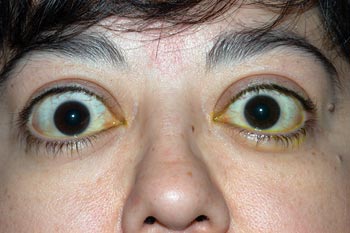
Thyroid eye disease (Graves' ophthalmopathy) is the most common cause of acquired unilateral or bilateral lid retraction. Thyroid disease may produce lid retraction (Slide 1) due to excess sympathetic activity, levator fibrosis, or contracture of the inferior rectus muscle. Maldevelopment or fibrosis of the levator apparatus may cause unilateral or bilateral lid retraction at birth and may be associated with other congenital abnormalities. Other myopathic causes of lid retraction include hypokalemic or hyperkalemic periodic paralysis and myotonic muscular dystrophy. Myogenic eyelid retraction may also occur after botulinum toxin injections of the eyelids and after eye surgery, including superior rectus recession, ptosis repair, and enucleation.
Mechanical Lid Retraction
Prominent globes (e.g., high myopia, buphthalmos, proptosis, cherubism, craniosynostosis, or Paget's disease) may cause mechanical lid retraction. Cicatricial scarring of the eyelid may also produce mechanical lid retraction. Several other causes of mechanical lid retraction should be considered including contact lens wear (including a lost lens under eyelid), neoplastic (e.g., eyelid tumors), infectious (e.g., herpes zoster ophthalmicus), inflammatory (e.g., atopic dermatitis, scleroderma) or post-traumatic (e.g., thermal, radiation, or chemical burns), or post-surgical (e.g., trabeculectomy, scleral buckle, frontal sinusotomy, blepharoplasty over-correction, orbicularis myectomy, cataract extraction, inferior rectus recession) etiologies.
Evaluation
The evaluation of lid retraction should begin with a complete medical and surgical history. Prior infectious, inflammatory, metabolic (e.g., thyroid disease), neoplastic, and traumatic disease should be documented. A patient should be questioned regarding any previous eyelid, extraocular muscle, or orbital surgery.
A complete ocular examination should be performed including visual acuity, visual field testing, pupil examination (for anisocoria in light and dark, light and near reaction), motility examination, Hertel exophthalmometry, slit lamp biomicroscopy, IOP measurements, and ophthalmoscopy. The amount of lid retraction should be documented. Evidence for pseudoretraction should be elicited (e.g., hypoglobus, contralateral ptosis, myasthenia gravis). The absence of other localizing signs or symptoms should be documented (e.g., lack of anisocoria, lid scarring, dorsal midbrain signs, ophthalmoplegia). Mechanical etiologies can generally be excluded by a careful external and slit lamp examination. Motility examination should be performed to exclude aberrant regeneration of the third nerve and myasthenia gravis.
The presence of proptosis, lid lag, lid edema, or ophthalmoplegia with the retraction should prompt evaluation for thyroid eye disease. Laboratory testing (e.g., thyroid stimulating hormone) for systemic thyroid disease or a history of autoimmune thyroid disease (e.g., Graves' disease or Hashimoto's thyroiditis) may be confirmatory. Some patients with thyroid ophthalmopathy have no serologic evidence for thyroid disease. Thyroid autoantibodies may be useful in testing for euthyroid Graves' ophthalmopathy. Orbital ultrasound or orbital computed tomography may confirm thyroid eye disease.
Treatment
The treatment of lid retraction should be aimed at the underlying etiology. Botulinum toxin injection can be used to reduce the lid retraction in symptomatic cases. Surgical treatment of the lid retraction may be useful for cosmetically unacceptable disease. If orbital decompression or strabismus surgeries are also required, then it is generally recommended that lid surgery be reserved for the final surgery as orbital decompression or strabismus surgeries may alter the position of the lid postoperatively.
Bibliography
Akdal G, Kutluk K, Men S, Yaka E. Benedikt and "plus-minus lid" syndromes arising from posterior cerebral artery branch occlusion. J Neurol Sci. 2005;228:105-107.
Al-Din AN, Anderson M, Eeg-Olofsson O, et al. Neuro-ophthalmic manifestations of the syndrome of ophthalmoplegia, ataxia, and areflexia. A review. Acta Neurol Scand. 1994;89:157-163.
Bartley GB. The differential diagnosis and classification of eyelid retraction. Ophthalmology. 1996;103:168-176.
Bartley GB, Gorman CA. Hepatic cirrhosis as a doubtful cause of eyelid retraction. Am J Ophthalmol. 1991;111:109-110.
Biglan AW. Control of eyelid retraction associated with Graves' disease with botulinum A toxin. Ophthalmic Surg. 1994;25:186-188.
Brazis PW, Vogler JB, Shaw KE. The 'numb-cheek-limp lower lid' syndrome. Neurology. 1991;41:327-328.
Ceisler EJ, Bilyk JA, Rubin PA, et al. Results of Mullerectomy and levator aponeurosis transposition for the correction of upper eyelid retraction in Graves' disease. Ophthalmology. 1995;102:483-492.
Collin JR, Allen L, Castronuovo S. Congenital eyelid retraction. Br J Ophthalmol. 1990;74:542-544.
Ebner A. Botulinum toxin type A in upper lid retraction of Graves' ophthalmopathy. J Clin Neuro-ophthalmol. 1993;13:258-261.
Ezra E, Plant GT. Paroxysmal superior rectus and levator palpabrae spasm: A unique presentation of multiple sclerosis. Br J Ophthalmol. 1996;80:187-188.
Feldon SE, Levin L. Graves' ophthalmopathy: Etiology of upper eyelid retraction in Graves' ophthalmopathy. Br J Ophthalmol. 1990;74:484-485.
Friedman DI, Jankovic J, McCrary JA. Neuro-ophthalmic findings in progressive supranuclear palsy. J Clin Neuro-ophthalmol. 1992;12:104-109.
Galetta SL, Gray LG, Raps EC, Schatz NJ. Pretectal eyelid retraction and lag. Ann Neurol. 1993;33:554-557.
Galetta SL, Gray LG, Raps EC, et al. Unilateral ptosis and contralateral eyelid retraction from a thalamic-midbrain infarction. Magnetic resonance imaging correlation. J Clin Neuro-ophthalmol. 1993;13:221-224.
Galetta SL, Raps EC, Liu GT, et al. Eyelid lag without retraction in pretectal disease. J Neuro-ophthalmol. 1996;16:96-98.
Gaymard B, Huynh C, Laffont I. Unilateral eyelid retraction. J Neurol Neurosurg Psych. 2000;68:390-392.
Gaymard B, Lafitte C, Gelot A, de Toffol BL. Plus-minus syndrome. J Neurol Neurosurg Psych. 1992;55:846-848.
Gheradi RK, Chouaub S, Malapert D, et al. Early weight loss and high serum tumor necrosis factor-alpha in polyneuropathy, organomegaly, endocrinopathy, M protein, skin changes syndrome. Ann Neurol. 1994;35:501-505.
Gillies WE, Harris AJ, Brooks AM, et al. Congenital fibrosis of the vertically acting extraocular muscles: A new group of dominantly inherited ocular fibrosis with radiologic findings. Ophthalmology. 1995;102:607-612.
Kleinman MD, DiMario FJ Jr, Leconche DA, Zalneraitis EL. Benign transient downward gaze in preterm infants. Pediatr Neurol. 1994;10:313-316.
Kubis KC, Danesh-Meyer H, Bilyk JR, et al. Unilateral lid retraction during pregnancy. Survey Ophthalmol. 2000;45:69-76.
Leatherbarrow B, Kwartz J, Sunderland S, et al. The 'baseball' orbital implant: A prospective study. Eye. 1994;8:569-576.
Mauriello JA Jr, Palydowycz SB. Upper eyelid retraction after retinal detachment repair. Ophthalmic Surg. 1993;24:694-697.
Miller NR, Lee AG. Adult-onset acquired oculomotor nerve paresis with cyclic spasms: Relationship to ocular neuromyotonia. Am J Ophthalmol. 2004;137:70-76.
Miller NR. Hepatic cirrhosis as a cause of eyelid retraction. Am J Ophthalmol. 1991;112:94-95.
Rubin PAD, Bilyk JR, Shore JW. Orbital reconstruction using porous polyethylene sheets. Ophthalmology. 1994;101:1679-1708.
Schmidtke K, Buttner-Ennever JA. Nervous control of eyelid function. A review of clinical, experimental and pathologic data. Brain. 1992;115:227-247.
Shih MJ, Liao SL, Lu HY. A single transcutaneous injection with Botox for dysthyroid lid retraction. Eye. 2004;18:466-469.
Smitt MC, Donaldson SS. Radiotherapy is successful treatment of orbital lymphoma. Int J Rad Oncol Biol Phys. 1993;26:59-66.
Sporarkar CNS, Patrinely JR, Cuaycong MJ, et al. The silent sinus syndrome. A cause of spontaneous enophthalmos. Ophthalmology. 1994;101:772-778.
Stout AU, Borchert M. Etiology of eyelid retraction in children: A retrospective study. J Pediatr Ophthalmol Strabismus. 1993;30:96-99.
Tan E, Kansu T, Kirkali P, Zileli T. Lid lag and the Guillain-Barre syndrome. J Clin Neuro-ophthalmol. 1990;10:121-123.
Vetrugno R, Mascalchi M, Marulli D, et al. Plus minus lid syndrome due to cerebral glioma. A case report. J Neuro-ophthalmology. 1997;18:149-151.
Wan MK, Francis IC, Carter PR, et al. The spectrum of presentation of silent sinus syndrome. J Neuro-ophthalmology. 2000;20:207-212.
Weinstein GS, Myers BB. Eyelid retraction as a complication of an embedded hard contact lens. Am J Ophthalmol. 1993;116:102-103.