Introduction
Mild to moderate degrees of hyperopia can be successfully managed with currently available surgical techniques, including tissue removal procedures (e.g., photorefractive keratectomy [PRK] and laser in situ keratomileusis [LASIK]) and tissue shrinkage procedures (e.g., holmium laser thermokeratoplasty and conductive keratoplasty). However, the surgical correction of hyperopia continues to present a challenge with lower rates of stability of outcome and higher rates of complications as compared to surgical correction of myopia.1
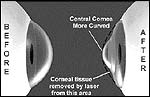
The challenge associated with keratorefractive surgery for treatment of hyperopia lies in the basic principle that correcting hyperopia requires steepening of the central cornea (Slide 1). This is done by shrinking stromal collagen or removing stromal tissue so as to flatten the paracentral and midperipheral cornea adjacent to and outside of the central cornea. Then, to access this region on the cornea during LASIK, a large corneal flap with a diameter of at least 9 mm must be created.2-3
Clinical Studies
After successful results of myopic LASIK trials were reported4-11 and the disappointing results of hyperopic PRK for high order hyperopic corrections were reported,12-17 investigators began studying the efficacy of LASIK for the correction of hyperopia. The earliest published studies were limited in follow-up as well as irreproducible results. Suarez and colleagues in 1996 reported a series of 326 eyes, most of which had simple hyperopia between 1 D and 8 D. A Schwind II excimer laser (Coherent, Palo Alto, Calif.) was used to ablate a hyperopic correction under an 8.5-mm flap with a 5.50-mm to 6-mm optical zone.18 No data beyond 3 months were reported, but these authors found 87% of the eyes to be within ± 0.5 D of emmetropia. In addition to their short follow-up, the researchers had a limited analysis of complications specific to the hyperopic LASIK as their patients were part of a larger cohort study.
Subsequent studies included a short-term investigation by Ojeimi and Waked in 1997.19 They treated 21 eyes with simple hyperopia of 3 D to 10.25 D using the Chiron (Emeryville, Calif,) automated corneal shaper and the Nidek (Fremont, Calif.) EC-5000 excimer laser with an 8.3-mm overall ablation diameter and a 5-mm optical zone. Their results did not correspond to Dr. Suarez's study; Ojeimi and Waked had an average 45% reduction of refractive error at a mean follow-up of 24 months. More recent studies have been published showing more promising results.
In 1999, Stephenson and colleagues treated 40 eyes with simple hyperopia of 3 D and 6 D and at 6 months found that 88% of the eyes were within ±1 D of emmetropia.20 Complications were few and included epithelial ingrowth (5%), loss of 2 lines of best-corrected visual acuity (2.5%), and an incomplete flap (2.5%).
The comparison and interpretation of results among published reports are difficult, as they have been varied in terms of selection criteria, surgical techniques, predictability, and success. Table 1 summarizes some of the studies on hyperopic and hyperopic astigmatic LASIK.21 Variables to consider that may affect the outcome are the excimer laser and the microkeratome used in each study, with associated variations in ablation diameters, optical zones, and ablation profiles. However, the trend points to higher predictability rates with laser systems that allow the ablation of large hyperopic optical zones (³6 mm). Also, it appears that in most published studies there was a trend for poorer outcomes and refractive instability for higher order corrections (> +5 D), although these outcomes were still better than the results seen in higher order hyperopic PRK corrections. The results are not as good as those reported for myopic LASIK, and there are several possible reasons for this difference. Patients who are hyperopic undergoing LASIK are, on average, approximately 2 decades older than patients who are myopic undergoing the procedure. Patients who are hyperopic effectively accommodate, so that they can function without optical correction until later in life. Differences in wound healing, the likelihood of developing dry eye-associated complications postoperatively, and the likelihood of having epithelial adhesion problems with postoperative epithelial defects contribute to poorer results in older patients. The difference in wound healing may contribute to the long-term fluctuation of visual acuity after LASIK in hyperopes compared to myopes. The technology to allow creation of larger diameter flaps and larger diameter ablations, with outer ablation zone diameters of 9.0 mm or greater, has only become available recently. Thus, hyperopic surgery is probably years behind myopic surgery in terms of refinement of surgical equipment, techniques, and ablation algorithms.
Summary
Hyperopic LASIK has been proved to be relatively safe and effective for up to 6 D of hyperopia (compared to similar degrees of myopia), with the best results obtained in patients with up to 4 D of hyperopia. Although more severe degrees of myopia are treatable with myopic LASIK (with approval up to -14 D), hyperopes are often appreciative of the results of surgery and more tolerant of a less than perfect outcome because they typically lack both distance and near vision without correction.
References
-
Chayet AS, Magallanes R, Montes M, et al. Laser in situ keratomileusis for simple myopic, mixed, and simple hyperopic astigmatism. J Refract Surg. 1998;14(Suppl):S175-S176.
-
Argento CJ, Cosentino MJ, Biondini A. Treatment of hyperopic astigmatism. J Cataract Refract Surg. 1997;23:1480-1490.
-
Ditzen K, Huschka H, Pieger S. Laser in situ keratomileusis for hyperopia. J Cataract Refract Surg. 1998;24:42-47.
-
Gartry DS, Kerr Muir MG, Marshall J. Photorefractive keratectomy with an argon fluoride excimer laser: A clinical study. Refract Corneal Surg. 1991;7:420-435.
-
Seiler T, Wollensak J. Myopic photorefractive keratectomy with the excimer laser. Ophthalmology. 1991;98:1156-1163.
-
Pallikaris IG, Papatzanaki ME, Stathi EZ, et al. Laser in situ keratomileusis. Lasers Surg Med. 1990;10:463-468.
-
Pallikaris IG, Papatzanaki ME, Siganos DS, Tsilimbaris MK. A corneal flap technique for laser in situ keratomileusis: human studies. Arch Ophthalmol. 1991;109:1699-1702.
-
Pallikaris IG, Siganos DS. Laser in situ keratomileusis to treat myopia: early experience. J Catarct Refract Surg. 1997;23:39-49.
-
Buratto L, Ferrar M. Indications, techniques, results, limits and complications of laser in situ keratomileusis. Curr Opin Ophthalmol. 1997;8:59-66.
-
Sanchez-Thorin JC, Barraquer-Granados JI. Myopic laser assisted keratomileusis: an overview of published results. Int Ophthalmol Clin. 1996;36:53-63.
-
Yo C, Vroman C, Ma S, Chao L, McDonnell PJ. Surgical outcomes of photorefractive keratectomy and laser in situ keratomileusis by inexperienced surgeons. J Cataract Refract Surg. 2000;26:510-515.
-
Dausch D, Klein R, Schroder E. Excimer laser photorefractive keratectomy for hyperopia. Refract Corneal Surg. 1993;9:20-28.
-
Anschutz T. Laser correction of hyperopia and presbyopia. Int Ophthalmol Clin. 1994;34:107-137.
-
Pietila J, Makinen P, Pafari S, Uusitala H. Excimer laser photorefractive keratectomy for hyperopia. J Refract Surg. 1997;13:504-510.
-
WB Jackson, E Casson, WG Hodge, G Mintsioulis, and PJ Agapitos. Laser vision correction for low hyperopia. An 18-month assessment of safety and efficacy. Ophthalmology. 1998;105:1727-1738.
-
Hori-Komai Y, Toda I, Asano-Kato N, Tsubota K. Reasons for not performing refractive surgery. J Cataract Refract Surg. 2002;28:795-797.
-
Moller-Pedersen T, Cavanagh HD, Petroll WM, Jester JV. Stromal wound healing explains refractive instability and haze development after photorefractive keratectomy: a 1-year confocal microscopic study. Ophthalmology. 2000;107:1235-1245.
-
Suarez E, Torres F, Duplessie M. LASIK for correction of hyperopia and hyperopia with astigmatism. Int Ophthalmol Clin. 1996, 36:65-72.
-
Ojeimi G, Waked N. Laser in situ keratomileusis for hyperopia. J Refract Surg. 1997;13(Suppl):S432-S433.
-
Stephenson CG, O'Brart DPS, Baldwin HC, Ilari L, Marshall J. A comparison of hyperopic surface photorefractive keratectomy (H-PRK) and hyperopic LASIK (H-LASIK) using a purpose designed ablatable disc system. Ophthalmology. 1999;9:(in press).
-
Salz JJ, Stevens CA. LASIK correction of spherical hyperopia, hyperopic astigmatism, and mixed astigmatism with the LADARVision excimer laser system. Ophthalmology 2002;109:1647-1657.