Introduction
Dry eye is a common condition seen with increased prevalence in patients with autoimmune disease1 and in the elderly. In a population-based prevalence study of individuals 65 years of age or older, 14.6% of 2,482 patients reported symptoms suggestive of dry eye. Extrapolating these numbers to the U.S. population suggests there are 4.3 million Americans with dry eye. Yet, the condition remains remarkably under diagnosed.2-3
Diagnosis
Diagnosing dry eye begins with the patient history but remains a difficult problem, as evidenced by the numerous diagnostic tests available. Tear film osmolarity, tear lysozyme and tear lactoferrin concentrations, and conjunctival impression cytology are helpful tests that are rarely employed outside of a research setting. The clinician generally relies upon the history in conjunction with the Schirmer testing (with or without anesthesia), supravital conjunctival staining, tear film break-up time, tear fluorescein clearance, tear meniscus height, and the presence or absence of tear film debris. Delayed tear flourescein clearance was reported to show better correlation with the severity of ocular irritation symptoms and keratoconjunctivitis sicca than the Schirmer 1 test.4,5
Lissamine green is a new supervital stain that combines the diagnostic advantages of fluorescein and rose bengal. Lissamine green stains healthy epithelial cells when they are not protected by a mucin layer in a manner similar to rose bengal. It also stains dead or degenerated cells like fluorescein.6-8 There is rarely ocular discomfort with Lissamine green. Lissamine green avoids the ocular discomfort and the corneal toxicity associated with the use of rose bengal, and it is extremely helpful in diagnosing dry eye as well as other tear film abnormalities.6,7,9,10 The use of supravital staining in the evaluation of refractive surgery candidates can reduce the risk of complications and wound healing related to poor outcomes.
Classification
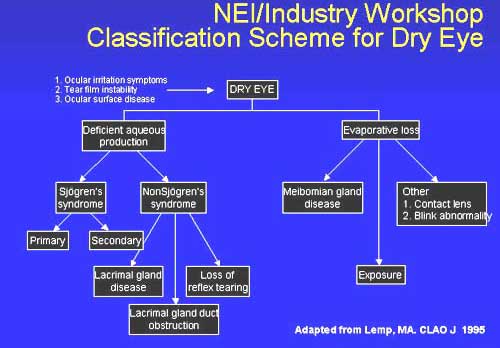
The National Eye Institute has proposed a classification system for dry eye based on the differentiation between deficient aqueous production and evaporative tear loss. There are multiple sub-groups in each of the two categories, and there is often significant crossover between the two groups. However, the classification system provides a starting point for a rational treatment plan for dry eye syndrome (Slide 1). Traditional therapy has included the use of artificial tears to supplement the patient's own tear production. For mild dry eye patients, preserved artificial tears have been effective, while for severe dry eye patients, non-preserved unit dose packs have gained widespread acceptance. Recently, transiently preserved artificial tears have been developed in which the preservative is dissipated upon exposure to sunlight. For patients in whom artificial tears are not sufficient, punctal occlusion can be effective in preserving the natural tears and prolonging the effect of artificial tears that have been instilled.11
Pathogenesis
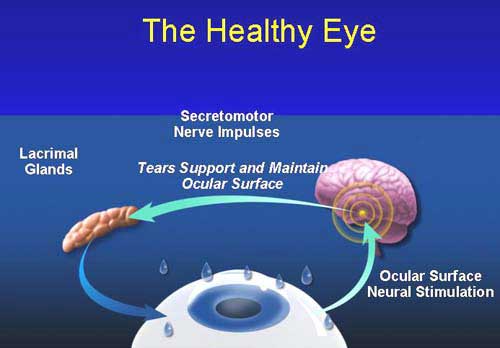
One major advance in dry eye over the past decade is the recognition that the ocular surface and lacrimal glands function as an integrated unit (Slide 2). Communication between these tissues occurs through a sensory/autonomic neural reflex loop. The sensory nerves enervate the ocular surface and nasal mucosa synapse with efferent autonomic nerves in the brain stem that stimulate secretion of tear fluid and proteins by the lacrimal glands. Ocular surface sensitivity has been found to decrease as aqueous tear production and clearance of tears from the ocular surface decrease. This decrease in surface sensation in turn exacerbates dry eye due to a decrease in sensory-stimulated reflex tearing and decreased ability of the lacrimal glands to respond to ocular surface insults. This creates a vicious self-perpetuating cycle between the lacrimal glands and ocular surface.12,13
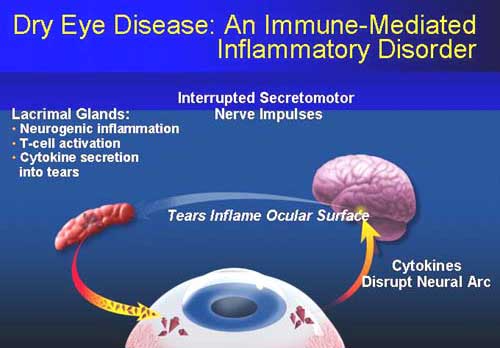
The importance of inflammation in the pathogenesis of dry eye disease has also been elucidated over the past decade (Slide 3). It has been found that decreased tear production and tear clearance lead to chronic inflammation on the ocular surface. This inflammatory response consists of inflammatory cell infiltration of the ocular surface, activation of the ocular surface epithelium with increased expression of adhesion molecules and inflammatory cytokines, increased concentrations of inflammatory cytokines in the tear fluid, and increased activity of matrix degrading enzymes such as MMP-9 in the tear fluid.14 Significant positive correlation has been observed between the levels of inflammatory cytokines in the conjunctival epithelium and the severity of ocular irritation symptoms, corneal fluorescein staining. They also correlate positively to the severity of conjunctival squamous metaplasia in patients with Sjögren's syndrome keratoconjunctivitis.15,16
Treatment
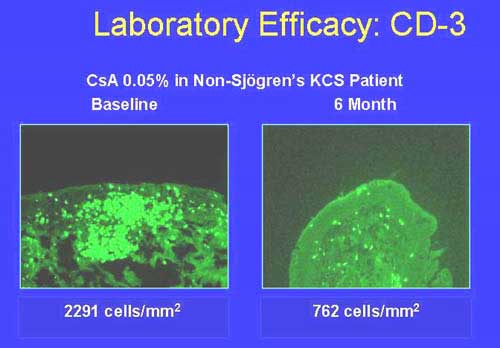
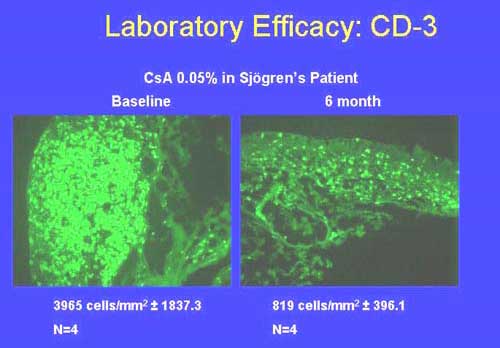
Reports of clinical efficacy of anti-inflammatory therapies for treatment of dry eye disease provide proof of the principle that inflammation is a key causative factor in dry eye. Topical corticosteroids were reported to improve irritation symptoms, redness, and the severity of keratoconjunctivitis sicca and to decrease levels of inflammatory cytokines.17 In a multicentered randomized trial (Slide 4 and Slide 5),18 opically applied Restasis (cyclosporine A, Allergan) was found to produce significant improvement in both signs and symptoms of dry eye disease, as well as a decrease in the levels of inflammatory factors in the conjunctival epithelium. There were no systemic effects from the topical Restasis with serum levels detectable in the trial.
Summary
Restasis offers the advantage of immunomodulation without the risk of corticosteroid side effects.
References
-
Fox RI, Howell FV, Bone RC, Michelson P. Primary Sjögren's syndrome: Clinical and immunopathologic features. Seminars in Arthritis and Rheumatology. 1984;14:77-105.
-
Schein OD, Munoz B, Tielsch JM, et al. Prevalence of dry eye among the elderly. Am J Ophthalmol. 1997;124:723-8.
-
Schein OD, Tielsch JM, Munoz B, et al. Relationship between signs and symptoms of dry eye in the elderly:A population-based perspective. Ophthalmology. 1997;104:1395-401.
-
Alfonso A, Monroy D, Tseng SCG, Stern M, Pflugflelder SC. Diagnostic Sensitivity and Specificity of Schirmer test and fluorescein clearance test for ocular irritation. Ophthalmology 1999;106:803-10.
-
Macri A, Pflugfelder S. Correlation of the Schirmer 1 and fluorescein clearance tests with the severity of corneal epithelial and eyelid disease. Arch Ophthalmology. 2000;118:1632.
-
Chodosh J, Dix R, Howell RC, Stoop WG, Tseng SCG. Staining characteristics and antiviral activities of sulfonhodamine B and Lissamine green. Invest Ophthalmol Vis Sci. 1994;35:1046-58.
-
Feenstra RBG, Tseng SCG. Comparison of fluorescein and rose bengal staining. Ophthalmology. 1992;110:984-93.
-
Kim J, Foulks G. Evaluation of the effect of Lissamine green and Rose Bengal on human corneal epithelial cells. Cornea. 1999;183:328-32.
-
Manning FJ, Wehely SR, Foulks GN. Patient tolerance and ocular surface staining characteristics of Lissamine green versus Rose Bengal. Ophthalmol. 1995;102:1953-7.
-
Lemp MA. Report of the National Eye Institute/Industry workshop on clinical trials on dry eyes. CLAO Journal. 1995;21:221-32.
-
American Academy of Ophthalmology. Punctal Occlusion for the Dry Eye: Three Year Revision. Ophthalmology. 1997;4(9):1521-4.
-
Stern ME, Beuerman RW, Fox RI, Gao J, Micreheff AK, Pflugfelder SC. The pathology of dry eye: The interaction between the ocular surface and lacrimal glands. Cornea. 1998;17:584-9.
-
Alfonso A, Monroy D, Tseng SCG, Stern M, Pflugfelder SC. Diagnostic sensitivity and specificity of Schirmer test and fluorescein clearance test for ocular irritation. Ophthalmology. 1999;106:803-10.
-
Pflugfelder SC, Jones D, Ji Z, Alfonso A, Monroy D. Altered cytokine balance in the tear fluid and conjunctiva of patients with Sjogren's syndrome keratoconjunctivitis sicca. Current Eye Research. 1999;19:201-11.
-
Alfonso A, Sobrin L, Monroy DC, Selzer M, Lokeshwar B, Pflugfelder SC. Tear fluid gelatinase B activity correlates with IL-1alpha concentration and fluorescein clearance in ocular rosacea. Invest Ophthalmol Vis Sci. 1999;40:2506-12.
-
Prabhasawat P, Tseng SCG. Frequent association of delayed tear clearance in ocular irritation. Br J Ophthalmol. 1998; 82:666-75.
-
Marsh P, Pflugfelder SC. Topical non-preserved methylprednisolone therapy of keratoconjunctivitis sicca. Ophthalmology. 1999;106:939-43.
-
Soll K, Stevenson OD, Mundoorf TK, Reis BL. Two multi-center, randomized studies of the efficacy and safety of Cyclosporine ophthalmic emulsion in moderate to severe dry eye disease. Ophthalmology. 2000;107(4):631-639.